

Étude de cas de l'intégration HiQ-Editor et TIDAS
Étude de cas détaillée sur la manière dont l'outil HiQ-Editor de Haike Data s'intègre à et utilise l'architecture de données TIDAS
Vue d'ensemble
L'intégration entre HiQ-Editor et TIDAS est significative car :
-
Elle facilite les échanges de données ACV pour les utilisateurs tels que les entreprises, les institutions de recherche et les gouvernements, permettant des évaluations d'impact environnemental utilisant des données mondiales tout en assurant l'universalité et la comparabilité des données.
-
Elle facilite l'interaction des données ACV (comme ELCD, HiQLCD) entre différentes plateformes, évitant les silos de données et améliorant l'interopérabilité.
-
L'utilisation d'une structure de données unifiée et d'exigences de qualité rend les données ACV plus standardisées, transparentes et traçables, assurant l'intégrité et la cohérence des données tout en améliorant la fiabilité.
Prérequis
-
Permissions de compte TIDAS
-
Connaissance de base du schéma TIDAS
-
Permissions de compte HiQ-Editor
Méthodes d'intégration de données
HiQ-Editor s'intègre principalement à TIDAS par :
-
Import/export au format ILCD pour prendre en charge le flux de données entre les systèmes
-
Interfaces API pour la révision et le transfert de données
Étapes d'intégration
Import/Export de données
-
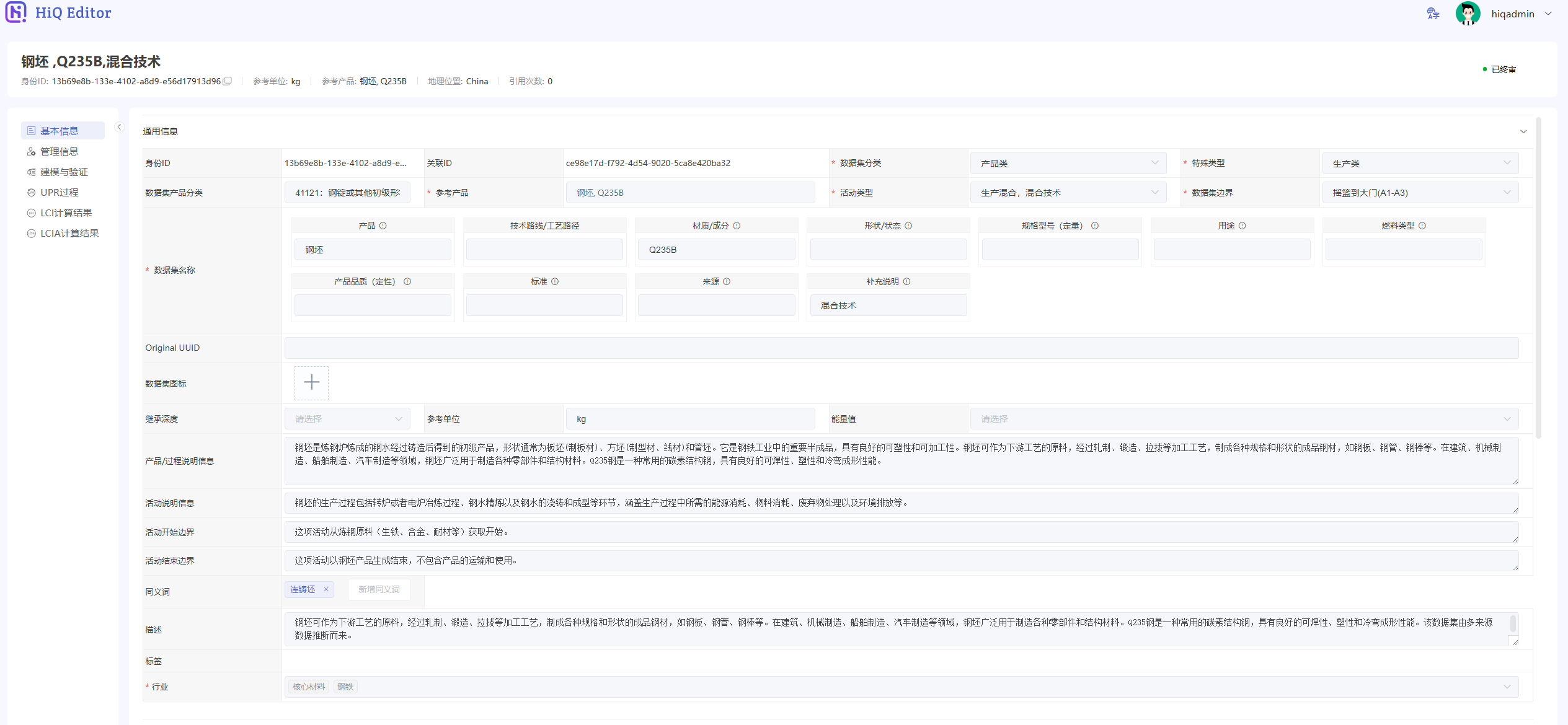
Les utilisateurs (éditeurs) modifient les données dans HiQ-Editor.
-
Les utilisateurs (gestionnaires) effectuent les calculs LCIA sur une version de données dans HiQ-Editor et la publient.
-
Les utilisateurs sélectionnent les données à exporter - le système analyse le schéma de données ACV de HiQ-Editor et exporte sous forme de document conforme ILCD.
-
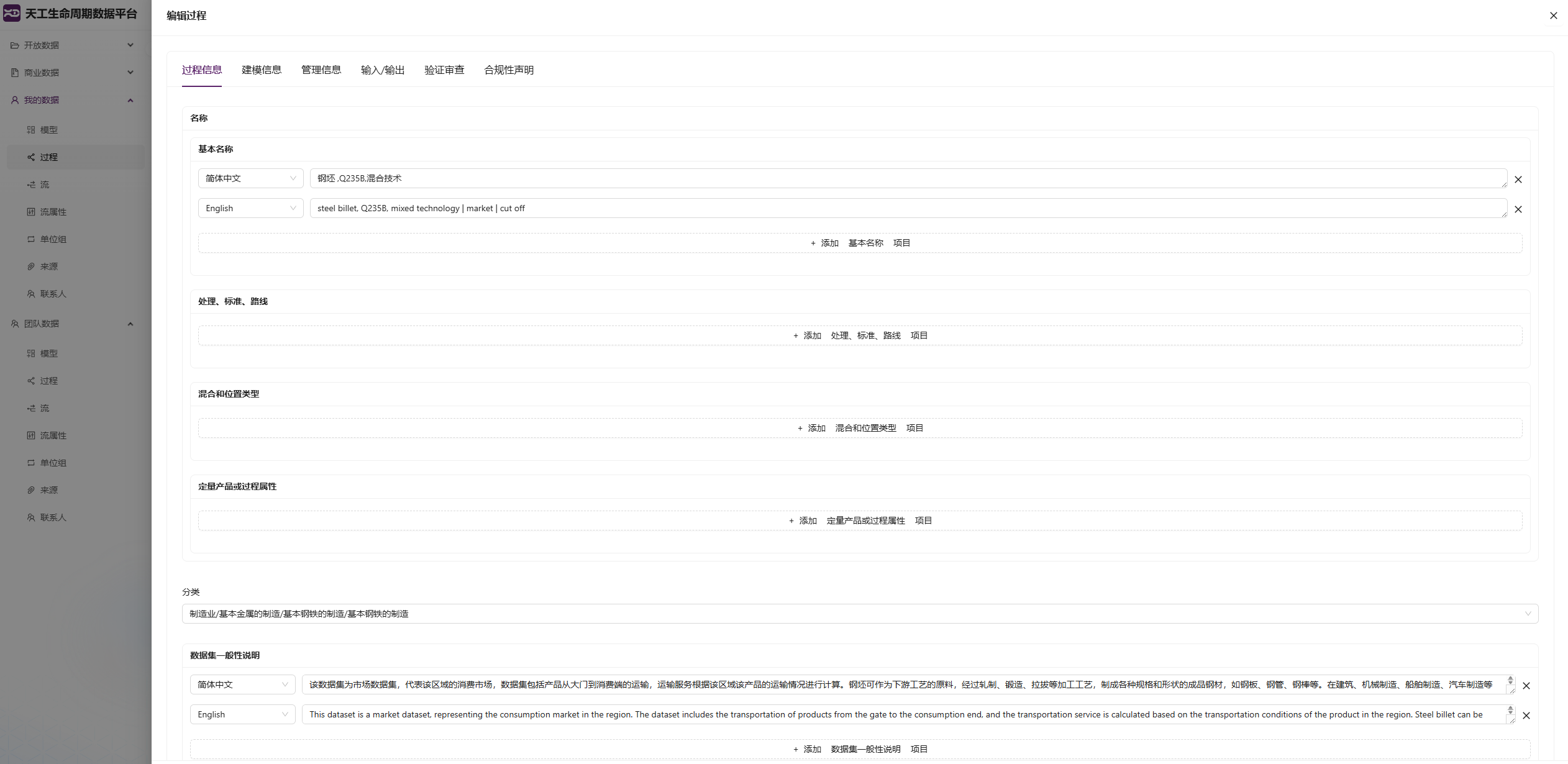
Les utilisateurs importent et analysent le document ILCD dans le système TIDAS.
Révision et transfert de données
-
Les utilisateurs (éditeurs) modifient les données dans HiQ-Editor et les soumettent pour révision.
-
HiQ-Editor établit une connexion API avec TIDAS pour vérifier les droits d'accès.
-
Les données soumises sont transmises à TIDAS pour révision via l'interface d'intégration.
-
Les utilisateurs (réviseurs) révisent et valident les données dans le système TIDAS, avec support pour renvoyer le contenu/résultats de la révision à HiQ-Editor.
Scénario d'exemple
{
  "processInformation": {
    "dataSetInformation": {
      "common:UUID": "ffea4eb0-bd87-4d20-bd17-9928865401bb",
      "name": {
        "baseName": [
          {
            "#text": "钢坯 ,Q235B,混合技术",
            "@xml:lang": "zh"
          },
          {
            "#text": "steel billet, Q235B, mixed technology | market | cut off",
            "@xml:lang": "en"
          }
        ]
      },
      "classificationInformation": {
        "common:classification": {
          "common:class": {
            "id": [
              "C",
              "24",
              "241",
              "2410"
            ],
            "value": [
              "Manufacturing",
              "Manufacture of basic metals",
              "Manufacture of basic iron and steel",
              "Manufacture of basic iron and steel"
            ]
          }
        }
      },
      "common:generalComment": [
        {
          "#text": "该数据集为市场数据集,代表该区域的消费市场,数据集包括产品从大门到消费端的运输,运输服务根据该区域该产品的运输情况进行计算。钢坯可作为下游工艺的原料,经过轧制、锻造、拉拔等加工工艺,制成各种规格和形状的成品钢材,如钢板、钢管、钢棒等。在建筑、机械制造、船舶制造、汽车制造等领域,钢坯广泛用于制造各种零部件和结构材料。Q235钢是一种常用的碳素结构钢,具有良好的可焊性、塑性和冷弯成形性能。该数据集通过多个来源的数据合并形成。",
          "@xml:lang": "zh"
        },
        {
          "#text": "This dataset is a market dataset, representing the consumption market in the region. The dataset includes the transportation of products from the gate to the consumption end, and the transportation service is calculated based on the transportation conditions of the product in the region. Steel billet can be used as raw material for downstream processes, and after processing technologies such as rolling, forging, and wire drawing, it is made into finished steel products in various specifications and shapes such as steel plates, steel pipes, and steel bars. In the fields of construction, machinery manufacturing, shipbuilding, and automobile manufacturing, steel billets are widely used to manufacture various components and structural materials. Q235 steel is a commonly used carbon steel with good weldability, ductility, and cold bending forming properties. The dataset was formed by aggregating data from multiple sources.",
          "@xml:lang": "en"
        }
      ]
    },
    "time": {
      "common:referenceYear": "2022"
    },
    "geography": {
      "locationOfOperationSupplyOrProduction": {
        "@location": "CN-HL"
      }
    },
    "technology": {
      "technologyDescriptionAndIncludedProcesses": [
        {
          "#text": "钢铁冶炼工艺主要包括转炉炼钢技术和电炉炼钢技术。转炉炼钢是一种常见的钢铁冶炼工艺,在冶炼过程中,通过高温燃烧和氧气吹炼,去除钢水中的杂质,如硫、磷等。通过控制氧气的吹入量和生产时间,调节炉内的氧气气氛和反应条件,从而控制合金的成分和质量。随后将熔化精炼后的钢水经钢包运至回转台,回转台转动到浇注位置后,将钢水注入中间包,中间包再由水口将钢水分配到各个结晶器中,经过冷却凝固后形成成型的粗钢坯料。电弧炉炼钢是利用电弧的热效应加热炉料进行熔炼的炼钢方法。通过石墨电极向电弧炼钢炉内输入电能,以电极端部和炉料之间发生的电弧为热源进行炼钢。电弧炉炼钢以废钢为主要原料,合金、石灰、增碳剂等为辅助原料。电弧炉炼钢的基本工艺包括扒渣补炉、装入金属炉料、送电、熔化、氧化、还原精炼和出钢等。此单元过程电炉炼钢的废钢比约40%。",
          "@xml:lang": "zh"
        },
        {
          "#text": "Steelmaking technologies primarily include converter steelmaking technology and EAF steelmaking technology. Converter steelmaking is a common technology in the field, wherein the refining process, high-temperature combustion and oxygen blowing is used to remove impurities from the molten steel, such as sulfur, phosphorus, etc. By controlling the amount of oxygen blown and the production time, the oxygen atmosphere within the furnace and the reaction conditions are regulated to control the composition and quality of the alloyed steel. Molten refined steel is subsequently transported to a rotating platform via a ladle. Once the platform rotates to the casting position, the molten steel is poured into a tundish, from which the steel is distributed via spout to multiple crystallizers. After cooling and solidification, these form shaped crude steel billets. Electric arc furnace steelmaking is a steelmaking method that uses the thermal effect of electric arcs to heat and smelt furnace materials. Electrical energy is input into the electric arc furnace through graphite electrodes, using the electric arc between the electrode tip and furnace material as the heat source for steelmaking. Electric arc furnace steelmaking primarily uses scrap steel as the main raw material, with alloy, limestone, and carbon enhancers used as auxiliary materials. The basic process of electric arc furnace steelmaking includes slag removal and furnace supplementation, loading of metallic furnace materials, power feeding, melting, oxidation, reduction refining, and steel tapping. In this unit process, the scrap steel ratio of electric arc furnace steelmaking is approximately 40%.",
          "@xml:lang": "en"
        }
      ],
      "technologicalApplicability": [
        {
          "#text": "钢铁冶炼工艺主要包括转炉炼钢技术和电炉炼钢技术。转炉炼钢是一种常见的钢铁冶炼工艺,在冶炼过程中,通过高温燃烧和氧气吹炼,去除钢水中的杂质,如硫、磷等。通过控制氧气的吹入量和生产时间,调节炉内的氧气气氛和反应条件,从而控制合金的成分和质量。随后将熔化精炼后的钢水经钢包运至回转台,回转台转动到浇注位置后,将钢水注入中间包,中间包再由水口将钢水分配到各个结晶器中,经过冷却凝固后形成成型的粗钢坯料。电弧炉炼钢是利用电弧的热效应加热炉料进行熔炼的炼钢方法。通过石墨电极向电弧炼钢炉内输入电能,以电极端部和炉料之间发生的电弧为热源进行炼钢。电弧炉炼钢以废钢为主要原料,合金、石灰、增碳剂等为辅助原料。电弧炉炼钢的基本工艺包括扒渣补炉、装入金属炉料、送电、熔化、氧化、还原精炼和出钢等。此单元过程电炉炼钢的废钢比约40%。",
          "@xml:lang": "zh"
        },
        {
          "#text": "Steelmaking technologies primarily include converter steelmaking technology and EAF steelmaking technology. Converter steelmaking is a common technology in the field, wherein the refining process, high-temperature combustion and oxygen blowing is used to remove impurities from the molten steel, such as sulfur, phosphorus, etc. By controlling the amount of oxygen blown and the production time, the oxygen atmosphere within the furnace and the reaction conditions are regulated to control the composition and quality of the alloyed steel. Molten refined steel is subsequently transported to a rotating platform via a ladle. Once the platform rotates to the casting position, the molten steel is poured into a tundish, from which the steel is distributed via spout to multiple crystallizers. After cooling and solidification, these form shaped crude steel billets. Electric arc furnace steelmaking is a steelmaking method that uses the thermal effect of electric arcs to heat and smelt furnace materials. Electrical energy is input into the electric arc furnace through graphite electrodes, using the electric arc between the electrode tip and furnace material as the heat source for steelmaking. Electric arc furnace steelmaking primarily uses scrap steel as the main raw material, with alloy, limestone, and carbon enhancers used as auxiliary materials. The basic process of electric arc furnace steelmaking includes slag removal and furnace supplementation, loading of metallic furnace materials, power feeding, melting, oxidation, reduction refining, and steel tapping. In this unit process, the scrap steel ratio of electric arc furnace steelmaking is approximately 40%.",
          "@xml:lang": "en"
        }
      ]
    }
  },
  "modellingAndValidation": {
    "LCIMethodAndAllocation": {
      "typeOfDataSet": "LCI result",
      "LCIMethodPrinciple": "Other"
    }
  },
  "administrativeInformation": {
    "dataGenerator": {
      "common:referenceToPersonOrEntityGeneratingTheDataSet": {
        "@refObjectId": "3d81d33c-3958-372e-b8a8-18fa35035231",
        "@type": "contact data set",
        "@uri": "../contacts/3d81d33c-3958-372e-b8a8-18fa35035231.xml"
      }
    },
    "dataEntryBy": {
      "common:timeStamp": "2024-12-31T13:03:35.762+08:00",
      "common:referenceToDataSetFormat": {
        "@refObjectId": "a97a0155-0234-4b87-b4ce-a45da52f2a40",
        "@type": "source data set",
        "@uri": "../sources/a97a0155-0234-4b87-b4ce-a45da52f2a40_01.01.000.xml",
        "@version": "01.01.000",
        "common:shortDescription": [
          {
            "#text": "ILCD format",
            "@xml:lang": "zh"
          }
        ]
      },
      "common:referenceToConvertedOriginalDataSetFrom": {},
      "common:referenceToPersonOrEntityEnteringTheData": {
        "@refObjectId": "3d81d33c-3958-372e-b8a8-18fa35035231",
        "@type": "contact data set",
        "@uri": "../contacts/3d81d33c-3958-372e-b8a8-18fa35035231.xml"
      },
      "common:referenceToDataSetUseApproval": {}
    },
    "publicationAndOwnership": {
      "common:dateOfLastRevision": "2024-12-15T15:02:45.862+08:00",
      "common:dataSetVersion": "01.01.000",
    }
  },
  "id": "ffea4eb0-bd87-4d20-bd17-9928865401bb",
  "exchanges": {
    "exchange": []
  }
}
FAQ
Q1 : Que faire si les données soumises depuis HiQ-Editor ne peuvent pas être transférées vers TIDAS ?
R : Vérifiez si les données dans HiQ-Editor ont passé la validation de complétude et leur statut de calcul - seules les données calculées peuvent être transférées à TIDAS pour révision.
Q2 : Que faire si certaines informations de champ sont manquantes après l'export ?
R : L'export HiQ-Editor suit les normes de format ILCD - les champs spécifiques aux exigences métier personnalisées qui ne font pas partie des spécifications ILCD ne seront pas inclus dans l'export.